
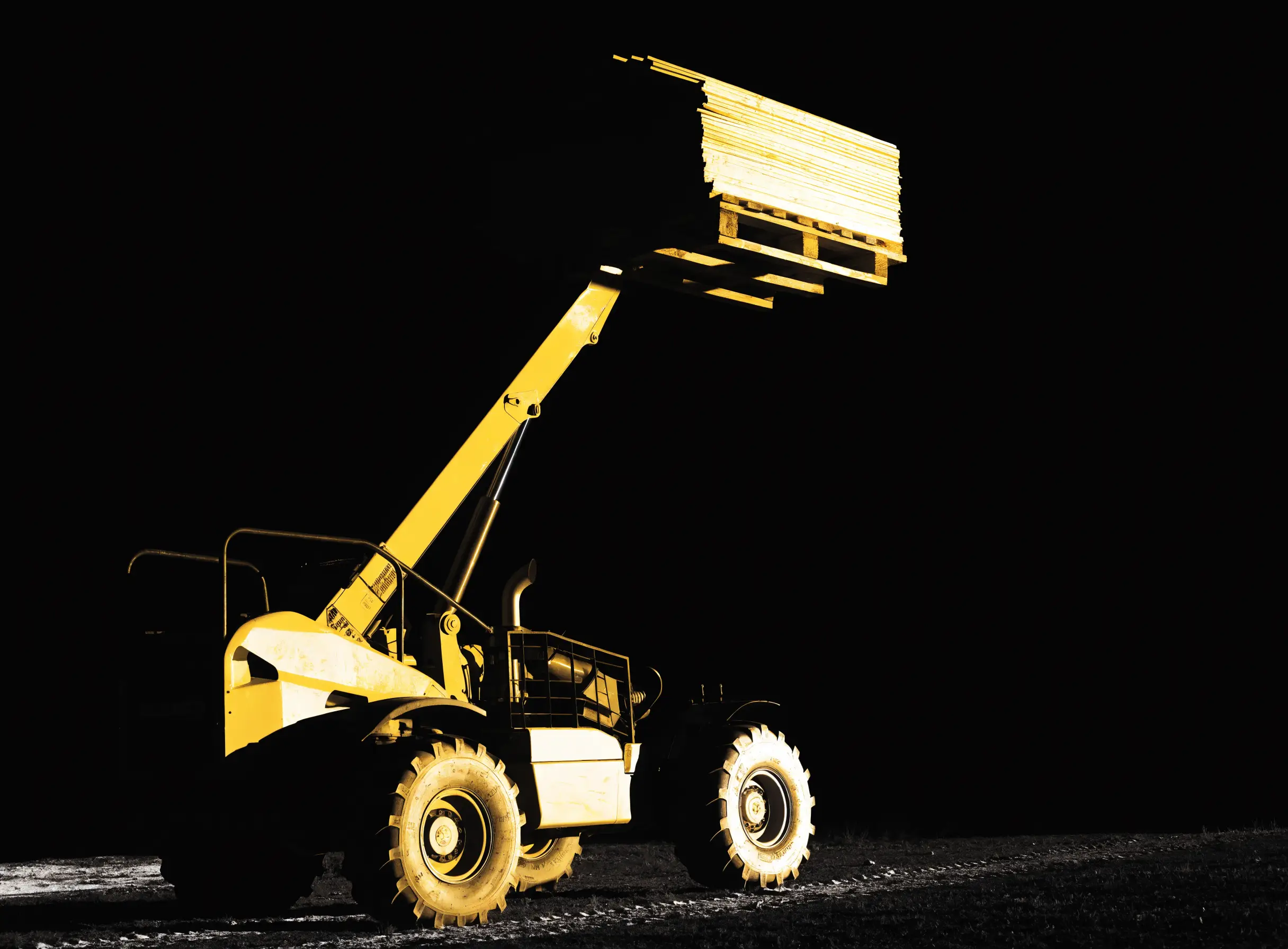
Telehandler reach charts, explained in one page
The chart on the cab door is the machine's real spec sheet. Reading it takes five minutes.
A telehandler is sold on two numbers: how high and how heavy. Those two numbers never happen at the same time. The chart on the cab door is where that gets explained, and it is worth five minutes.
What the chart is telling you
A load chart maps boom angle and extension against the weight the machine will hold there. The headline capacity is the best case: boom low, boom retracted, load tucked in close. Every metre you push the load away from the machine costs you capacity, and it does not cost it in a straight line.
This is not a manufacturer being cautious. It is a lever. The machine is a counterweight on one end and your load on the other, and the further out the load sits, the harder it pulls.
Read it in this order
- Find your load on the vertical axisHow high does it actually have to go? Measure it, do not eyeball it.
- Find your distance on the horizontal axisMeasured from the front of the machine to the load. This is the number people guess, and it is the number that bites.
- Find where those two meetThat point sits inside a capacity zone. That zone is your real limit at that position.
- Check it against the load you are liftingThe load, plus the attachment, plus whatever is strapped to it.
- If it lands outside the envelope, the answer is not "try it"Move the machine closer, or get the machine that reaches. Those are the two options.
The three things that quietly change the chart
- The attachment. Every carriage has its own chart. Forks, a bucket, and a jib are three different machines. A jib in particular moves the load away from the pivot before you lift anything.
- The stabilisers. Many charts print two envelopes: one on stabilisers, a smaller one on tyres. Using the wrong one is a common way to get a nasty surprise.
- The ground. The chart assumes level and firm. On a slope, the geometry the chart is describing is not the geometry you have.
Sizing before you rent
Do not shop for a telehandler by its maximum lift height. Shop for it by the worst lift on your job — the heaviest load at the furthest distance. If the machine covers that, it covers the rest. If you size for the headline number, you will discover the difference at the one lift that mattered.
Two measurements get you there: the weight of the heaviest thing you are placing, and how far from the machine you can actually park to place it. Send us both.
The plate and the chart should agree
If the chart on the door describes a carriage that is not fitted, the chart is describing a machine that no longer exists. Ask which carriage the chart is for. Every unit in our yard lists its figures, and we send the plate photo on request.